
Buying a property is one of the biggest financial decisions most people make in their lifetime. Whether you’re purchasing your first home, investing in a residential plot, buying agricultural land, or looking for a commercial property, every decision requires careful planning, legal verification, and market knowledge.
Over the past decade, Telangana has emerged as one of India’s fastest-growing real estate destinations. Rapid infrastructure development, IT expansion, industrial corridors, improved connectivity, and investor-friendly government policies have transformed cities like Hyderabad, Warangal, Sangareddy, Karimnagar, Nizamabad, Khammam, and many other districts into attractive investment hubs.
However, despite the growing opportunities, buying property without proper research can lead to costly mistakes. Fake documents, unauthorized layouts, title disputes, incorrect land records, and purchasing in areas with limited development potential are some of the common challenges faced by buyers.
This comprehensive guide is designed to help you confidently navigate every stage of the property-buying journey in Telangana. From choosing the right property and verifying legal documents to understanding registration procedures, financing options, taxes, and future investment opportunities, this guide covers everything you need to know.
Whether you are:
- A first-time home buyer
- A seasoned real estate investor
- An NRI looking to invest in Telangana
- Someone searching for HMDA-approved plots
- A family planning to build a dream home
- A business owner looking for commercial property
this guide will serve as your complete roadmap.
Why Invest in Telangana Real Estate?

Telangana has consistently ranked among the top-performing states in India for infrastructure development, urban planning, industrial growth, and ease of doing business. These factors have significantly increased the demand for residential, commercial, and plotted developments across the state.
Unlike many markets that experience unpredictable fluctuations, Telangana’s real estate sector has demonstrated long-term resilience, driven by strong economic fundamentals and sustained demand.
1. Rapid Infrastructure Development
Infrastructure is one of the biggest drivers of property appreciation, and Telangana has made remarkable progress in this area.
Several large-scale projects have improved connectivity and opened up new growth corridors across the state. These include:
- Outer Ring Road (ORR)
- Regional Ring Road (RRR)
- Metro Rail expansion
- Elevated corridors
- Strategic Road Development Programme (SRDP)
- New flyovers
- Airport connectivity improvements
- Industrial parks
- IT corridors
- Logistics hubs
Improved infrastructure not only reduces travel time but also increases the value of nearby residential and commercial properties.
2. Strong IT and Employment Growth
Hyderabad continues to be one of India’s leading IT destinations, attracting multinational companies, startups, and technology firms.
Global corporations continue expanding their operations, creating thousands of employment opportunities every year. This has generated sustained demand for:
- Apartments
- Villas
- Rental homes
- Commercial office spaces
- Retail properties
The influx of professionals has also strengthened the rental market, making Telangana attractive for long-term investors seeking rental income.
3. Government Initiatives Supporting Real Estate
The Telangana Government has introduced several initiatives aimed at promoting transparent and sustainable real estate development.
Some notable initiatives include:
- TS-bPASS for faster building approvals
- Digitization of land records
- Online property registration services
- RERA implementation
- Infrastructure investment
- Industrial policy reforms
- Smart city development
- New townships and planned layouts
These measures have increased buyer confidence and streamlined the property purchasing process.
4. Affordable Investment Opportunities
Compared to many other metropolitan regions, Telangana offers investment opportunities across a wide range of budgets.
Buyers can find:
- Residential apartments
- Premium villas
- HMDA-approved plots
- DTCP-approved layouts
- Farm lands
- Agricultural lands
- Commercial spaces
- Independent houses
- Gated community developments
This diversity allows both first-time buyers and experienced investors to choose properties that align with their financial goals.
5. High Appreciation Potential
Real estate appreciation largely depends on infrastructure, employment growth, and future development.
Many emerging locations across Telangana have witnessed significant appreciation over the last several years due to:
- New highways
- Industrial corridors
- Educational institutions
- Healthcare facilities
- IT expansion
- Improved public transport
- Commercial developments
Investing early in developing areas often provides better long-term returns than purchasing in already saturated markets.
Telangana Real Estate Market Overview
The Telangana property market is diverse, offering opportunities for homeowners, investors, businesses, and developers.
While Hyderabad remains the state’s largest real estate hub, several tier-2 cities and district headquarters are rapidly gaining attention due to infrastructure expansion and government investment.
Hyderabad
Hyderabad continues to dominate the state’s real estate market with strong demand across residential, commercial, and luxury segments.
Popular investment areas include:
- Kokapet
- Neopolis
- Financial District
- Gachibowli
- Narsingi
- Tellapur
- Kompally
- Bachupally
- Pocharam
- Shamshabad
- Adibatla
These locations benefit from excellent road connectivity, employment opportunities, educational institutions, and modern civic infrastructure.
Emerging Growth Corridors
Beyond Hyderabad, several districts are witnessing increasing real estate activity.
Examples include:
- Sangareddy
- Medchal-Malkajgiri
- Rangareddy
- Yadadri Bhuvanagiri
- Siddipet
- Karimnagar
- Warangal
- Khammam
- Nizamabad
- Mahabubnagar
Improved transportation networks and industrial expansion have made these locations attractive for both end-users and investors.
Residential Property Demand
Residential real estate remains one of the strongest segments in Telangana.
Popular categories include:
- Apartments
- Villas
- Independent houses
- Residential plots
- Gated communities
Demand is driven by:
- Growing urban population
- Rising income levels
- Migration for employment
- Better financing options
- Improved infrastructure
Commercial Property Growth
Commercial real estate has also experienced steady expansion.
Demand continues for:
- Office spaces
- Retail shops
- Warehouses
- Industrial land
- Business parks
- Mixed-use developments
With Telangana emerging as a major business destination, commercial property is expected to remain an attractive investment option.
Types of Properties Available in Telangana
Before purchasing any property, it’s important to understand the different categories available in the market. Each type serves a different purpose and comes with its own legal, financial, and investment considerations.

Residential Apartments
Apartments are among the most popular choices for families and working professionals. They are typically located in gated communities with amenities such as security, parking, power backup, clubhouses, and recreational facilities.
Best for:
- First-time home buyers
- Salaried professionals
- Rental income investors
Advantages:
- Lower maintenance responsibility
- Community amenities
- Good rental demand
- Better security
- Easier financing
Villas and Independent Houses
Villas offer greater privacy, more living space, and the flexibility to customize interiors and outdoor areas. They are generally located in gated communities or premium residential neighborhoods.
Suitable for:
- Families seeking larger homes
- Long-term homeowners
- Luxury buyers
Residential Plots
Buying a plot gives you the freedom to design and construct your home according to your preferences. Plotted developments are also a popular investment option because land often appreciates over time.
When purchasing a plot, buyers should verify:
- Layout approval
- Ownership documents
- Road access
- Encumbrance status
- Land use classification
- Development permissions
Agricultural Land
Agricultural land is primarily used for farming and related activities. Buyers should clearly understand applicable regulations before purchasing such land, especially if they plan to use it for non-agricultural purposes in the future.
Key considerations include:
- Ownership records
- Land classification
- Access roads
- Irrigation facilities
- Conversion rules (if applicable)
Farm Lands
Farm lands have become increasingly popular among investors looking for weekend retreats, sustainable living, or long-term land appreciation.
However, buyers should ensure the land complies with all relevant regulations and has clear ownership records.
Commercial Properties
Commercial investments include:
- Office spaces
- Retail shops
- Showrooms
- Commercial plots
- Warehouses
- Industrial units
These properties often offer higher rental yields but may require a larger initial investment and a thorough understanding of commercial market dynamics.
Residential vs. Commercial Property: Which Is Right for You?
Choosing between residential and commercial property depends on your financial goals, risk appetite, and intended use.
| Factor | Residential Property | Commercial Property |
|---|---|---|
| Initial Investment | Generally lower | Usually higher |
| Rental Demand | Consistent | Depends on business activity |
| Rental Yield | Moderate | Often higher |
| Risk Level | Lower | Moderate to high |
| Maintenance | Relatively simple | Can be more complex |
| Suitable For | Families, first-time buyers | Investors, businesses |
If your primary goal is homeownership or stable rental income, residential property may be the better choice. If you’re seeking potentially higher returns and are comfortable with greater market fluctuations, commercial property could be worth considering.
How to Choose the Right Location
One of the most important principles in real estate is that location plays a major role in determining a property’s long-term value. Even a well-built property may not perform as expected if it is in an area with poor connectivity or limited future development.
When evaluating a location in Telangana, consider the following factors:
- Proximity to workplaces and business hubs
- Access to schools, colleges, and universities
- Availability of hospitals and healthcare facilities
- Road connectivity and public transportation
- Water supply and electricity infrastructure
- Upcoming government projects and infrastructure plans
- Presence of shopping centers, banks, and daily conveniences
- Safety and overall neighborhood quality
- Potential for future appreciation
It’s also advisable to visit the location at different times of the day, speak with local residents, and assess the pace of ongoing development before making a final decision.
Step-by-Step Property Buying Process in Telangana
Buying a property is much more than selecting a house or plot that fits your budget. It involves financial planning, legal verification, due diligence, negotiation, and completing various government formalities. Skipping any of these steps can lead to financial losses or legal complications.
Whether you’re buying an apartment in Hyderabad, an HMDA-approved plot in Sangareddy, a villa in Rangareddy, or agricultural land in Adilabad, following a structured approach will help you make an informed and secure investment.
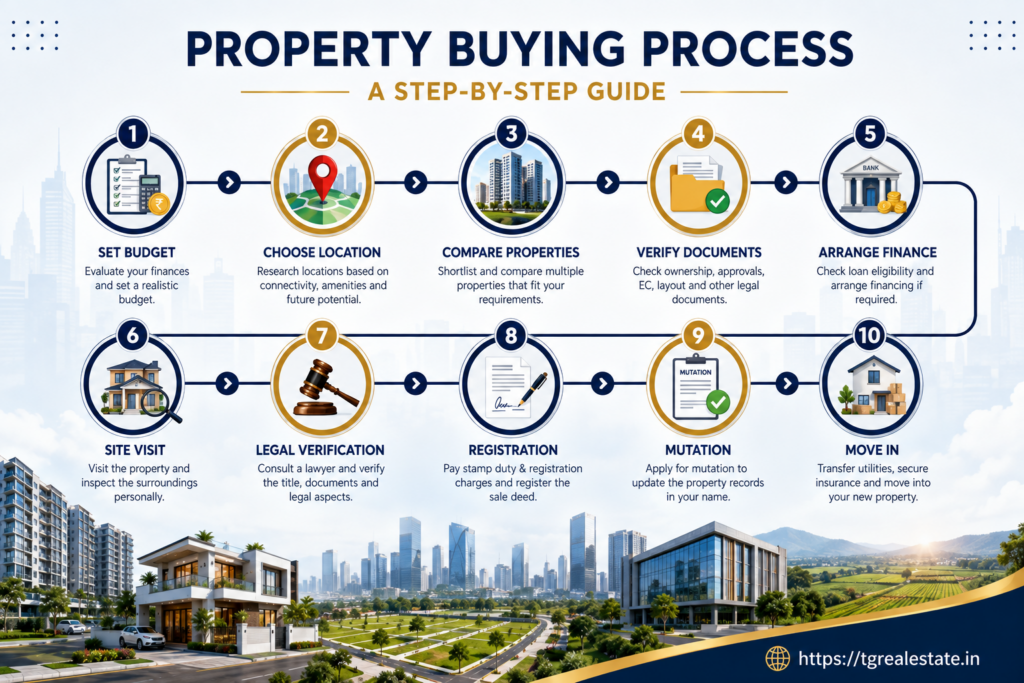
Let’s walk through each stage of the property buying process.
Step 1: Define Your Purpose
Before you begin searching for properties, clearly identify why you are buying.
Your objective influences the type of property, budget, financing, and location.
Ask yourself:
- Are you buying a home for your family?
- Is it a long-term investment?
- Are you planning to earn rental income?
- Do you want to build a house in the future?
- Are you buying commercial property for business use?
- Is the property meant for retirement?
Having a clear purpose prevents impulsive decisions and helps narrow your search.
Step 2: Set a Realistic Budget
Budget planning is one of the most important aspects of property buying. Many buyers focus only on the property’s advertised price and overlook additional expenses that can significantly increase the total cost.
Your budget should include:
- Property cost
- Booking amount
- Down payment
- Home loan processing fees
- Stamp duty
- Registration charges
- Legal verification charges
- GST (where applicable)
- Interior works
- Maintenance deposits
- Parking charges
- Utility connection fees
- Furniture and appliances
- Moving expenses
Example Budget Calculation
| Expense | Estimated Cost |
|---|---|
| Property Price | ₹60,00,000 |
| Stamp Duty & Registration | ₹3,50,000 |
| Legal Verification | ₹20,000 |
| Home Loan Charges | ₹30,000 |
| Interior Work | ₹4,00,000 |
| Furniture | ₹2,00,000 |
| Miscellaneous | ₹50,000 |
| Total Estimated Cost | ₹70,50,000 |
Planning for these additional costs helps you avoid financial strain after the purchase.
Step 3: Check Your Loan Eligibility
If you intend to finance the purchase through a home loan, assess your borrowing capacity before finalizing a property.
Lenders typically evaluate:
- Monthly income
- Existing loans
- Credit score
- Employment stability
- Age
- Repayment history
- Property documents
Tips to Improve Loan Approval Chances
- Maintain a healthy credit score.
- Avoid taking multiple loans before applying.
- Keep your income documents updated.
- Save for a higher down payment.
- Compare interest rates and loan terms from multiple banks and housing finance companies.
Getting a loan pre-approval can also strengthen your negotiating position with sellers.
Step 4: Choose the Right Location
Location has a direct impact on both your lifestyle and your property’s future value.
When evaluating an area, consider:
Connectivity
Look for easy access to:
- Major roads
- Highways
- Metro stations
- Railway stations
- Bus routes
- Airport
Good connectivity improves convenience and often leads to better property appreciation.
Educational Institutions
Families should consider proximity to:
- Schools
- Colleges
- Universities
- Coaching centers
Properties near reputed educational institutions tend to maintain steady demand.
Healthcare Facilities
Ensure the location has access to:
- Hospitals
- Clinics
- Pharmacies
- Emergency medical services
Employment Hubs
Buying near IT parks, industrial areas, or commercial districts can reduce commute times and improve rental demand.
Future Infrastructure
Research planned developments such as:
- New highways
- Ring roads
- Metro extensions
- Industrial parks
- IT corridors
- Educational institutions
- Government offices
- Commercial centers
Areas with upcoming infrastructure often offer stronger appreciation potential.
Step 5: Shortlist Suitable Properties
Once you’ve identified your preferred location, compare multiple properties instead of making a quick decision.
Evaluate each property based on:
- Price
- Size
- Road width
- Facing
- Layout
- Amenities
- Water availability
- Power supply
- Construction quality
- Builder reputation
- Resale potential
Visiting several properties helps you understand the local market and identify the best value.
Step 6: Verify Property Documents
Legal verification is one of the most critical steps in the buying process. Even an attractive property should not be purchased unless its ownership and approvals are thoroughly checked.
Essential Documents to Verify
Sale Deed
The Sale Deed confirms ownership and records the transfer of property from the seller to the buyer.
Verify that:
- The seller’s name matches government records.
- The property description is accurate.
- There are no discrepancies in survey numbers or boundaries.
Title Documents
A clear title establishes that the seller has legal ownership and the right to sell the property.
Check for:
- Continuous ownership history
- Absence of legal disputes
- Proper transfer of ownership through previous transactions
Encumbrance Certificate (EC)
The Encumbrance Certificate helps determine whether the property has any registered financial or legal liabilities, such as mortgages or court attachments.
A clean EC is an important indicator of a property’s legal status, though it should be reviewed alongside other documents.
Layout Approval
For plotted developments, verify that the layout has been approved by the appropriate planning authority.
Avoid purchasing plots in unauthorized or unapproved layouts, as they may face restrictions on construction or access to civic amenities.
Property Tax Receipts
Request the latest property tax receipts to confirm that taxes have been paid and there are no outstanding dues.
Building Permission
For apartments and independent houses, ensure the construction has received the required approvals from the competent authority.
Occupancy Certificate (OC)
For completed buildings, the Occupancy Certificate confirms that the structure has been built in accordance with approved plans and is fit for occupation.
Completion Certificate (CC)
The Completion Certificate indicates that the building has been completed as per sanctioned plans and applicable regulations.
Step 7: Understand HMDA, DTCP, and Gram Panchayat Layouts
One of the most common questions among buyers in Telangana is the difference between various layout approvals.
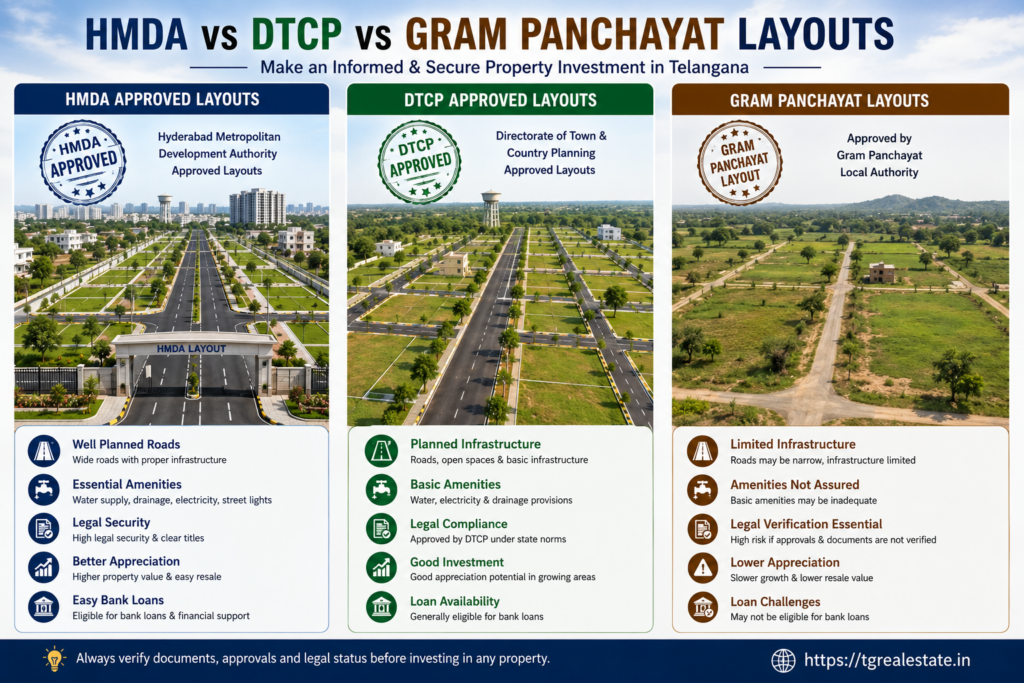
HMDA-Approved Layouts
HMDA (Hyderabad Metropolitan Development Authority) approvals generally apply to areas within its planning jurisdiction around Hyderabad.
Key advantages include:
- Planned road network
- Infrastructure standards
- Better long-term appreciation
- Greater buyer confidence
- Easier access to financing in many cases
DTCP-Approved Layouts
DTCP (Directorate of Town and Country Planning) approvals apply to many areas outside the HMDA jurisdiction.
These layouts also follow planning norms and are suitable for buyers looking beyond the Hyderabad metropolitan region.
Gram Panchayat Layouts
Some properties are located in Gram Panchayat areas.
Buyers should exercise additional caution and verify:
- Land use classification
- Layout approvals (where applicable)
- Building permissions
- Road access
- Future development plans
Purchasing without proper verification can create challenges during construction or resale.
Step 8: Verify RERA Registration
If you are buying a property in a project that falls under the Real Estate (Regulation and Development) framework, check whether the project is registered with the relevant authority.
Review details such as:
- Project registration number
- Approved plans
- Completion timelines
- Promoter information
- Project status
RERA registration improves transparency and provides buyers with access to important project information.
Step 9: Inspect the Property Personally
Never rely solely on brochures, advertisements, or online photos.
Visit the property multiple times and inspect:
- Construction quality
- Road access
- Drainage
- Water supply
- Electrical infrastructure
- Ventilation
- Natural lighting
- Neighborhood conditions
- Security
- Nearby developments
If possible, visit during different times of the day to assess traffic, noise levels, and overall surroundings.
Step 10: Research the Builder or Seller
Before making any payment, gather information about the builder or seller.
Consider:
- Previous projects
- Delivery history
- Customer reviews
- Legal disputes
- Financial stability
- Construction quality
- Reputation in the market
A strong track record can reduce the risk of delays or quality issues.
Step 11: Negotiate the Price
Property prices are often negotiable.
Factors that may strengthen your negotiation include:
- Market conditions
- Comparable property prices
- Payment schedule
- Construction stage
- Seller’s urgency
- Minor repairs or improvements required
In addition to the sale price, you may also negotiate:
- Parking charges
- Clubhouse fees
- Maintenance deposits
- Interior fittings
- Possession timelines
Step 12: Pay the Token Amount Carefully
Once you decide to proceed, the seller may request a token or booking amount to reserve the property.
Before making any payment:
- Obtain a written receipt.
- Ensure the property details are correctly mentioned.
- Confirm the terms for refund, if applicable.
- Avoid making large cash payments.
- Use traceable payment methods whenever possible.
Step 13: Sign the Sale Agreement
The Sale Agreement outlines the terms and conditions agreed upon by both parties before the final sale deed is executed.
It should clearly specify:
- Property description
- Sale price
- Payment schedule
- Possession date
- Responsibilities of buyer and seller
- Penalties for delays or default
- Other agreed terms
It is advisable to have the agreement reviewed by a qualified legal professional before signing.
Property Buying Checklist
Before proceeding with registration, ensure that you have completed the following:
- ✔ Finalized your budget
- ✔ Verified loan eligibility
- ✔ Selected the right location
- ✔ Compared multiple properties
- ✔ Verified ownership documents
- ✔ Reviewed the Encumbrance Certificate
- ✔ Confirmed layout approvals
- ✔ Checked RERA details (where applicable)
- ✔ Inspected the property
- ✔ Researched the builder or seller
- ✔ Negotiated the price
- ✔ Signed the Sale Agreement
- ✔ Collected all payment receipts
Completing this checklist significantly reduces the risk of legal or financial issues later.
Property Registration in Telangana
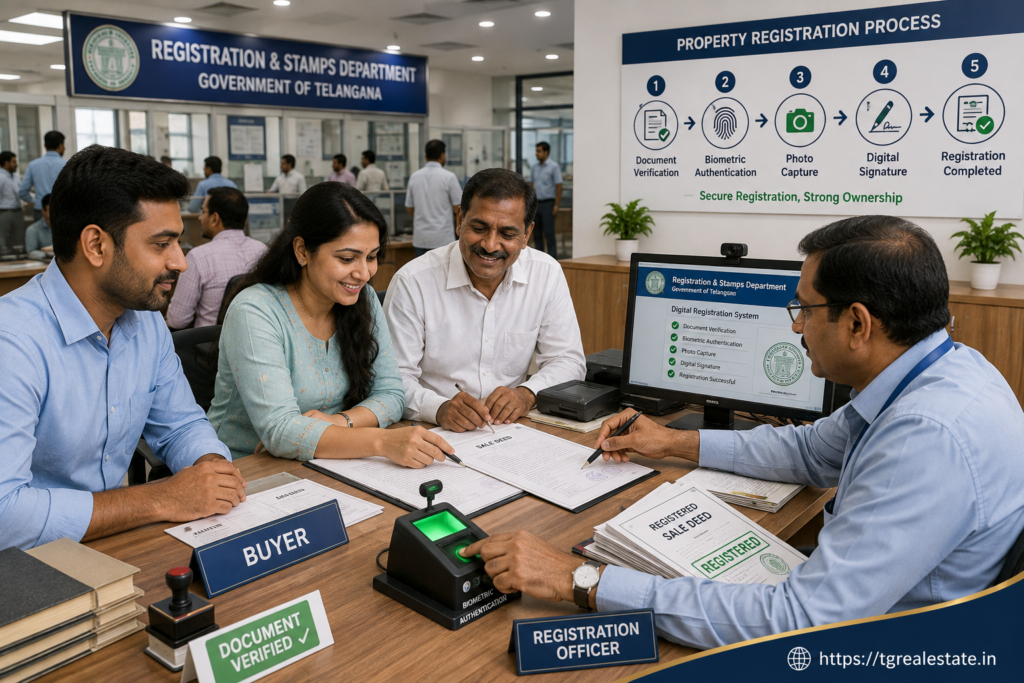
After you’ve selected the property, verified the documents, arranged financing, and signed the Sale Agreement, the next major step is property registration. Registration is the legal process through which ownership is officially transferred from the seller to the buyer.
In Telangana, property registration is carried out through the Registration & Stamps Department. Once the Sale Deed is registered and all applicable charges are paid, the buyer becomes the legal owner of the property.
Skipping or delaying registration can create legal complications, so it should be completed promptly after both parties fulfill the terms of the sale agreement.
Why Property Registration is Important
Property registration is more than just a legal formality. It provides official recognition of ownership and helps protect your rights as a buyer.
Some of the key benefits include:
- Establishes legal ownership of the property
- Creates a government record of the transaction
- Reduces the risk of ownership disputes
- Helps prevent fraudulent resale of the same property
- Makes future resale easier
- Simplifies inheritance and succession
- Facilitates loan approvals using the property as collateral
Without a properly registered Sale Deed, proving ownership in legal disputes can become difficult.
Documents Required for Property Registration
The exact documents required may vary depending on the type of property and the nature of the transaction. However, buyers should generally keep the following documents ready:
Identity Proof
Examples include:
- Aadhaar Card
- Passport
- Voter ID
- Driving Licence
Address Proof
Such as:
- Aadhaar Card
- Passport
- Utility Bill
- Bank Passbook
PAN Card
PAN is generally required for high-value property transactions and related tax compliance.
Sale Deed
The Sale Deed is the primary legal document that transfers ownership from the seller to the buyer.
Sale Agreement
If executed before registration, the Sale Agreement should also be available for reference.
Property Documents
These may include:
- Previous Sale Deeds
- Title documents
- Layout approvals
- Building approvals
- Occupancy Certificate (where applicable)
- Completion Certificate (where applicable)
Encumbrance Certificate
An updated Encumbrance Certificate helps confirm that the property is free from registered financial or legal liabilities.
Passport-size Photographs
Photographs of both buyer and seller are generally required during registration.
Witness Identity Proof
Registration usually requires witnesses, who should also carry valid identity documents.
Property Registration Process in Telangana
Understanding the registration process helps buyers prepare in advance and avoid unnecessary delays.
Step 1: Finalize the Sale Deed
The Sale Deed should accurately describe:
- Property boundaries
- Survey numbers
- Plot dimensions
- Consideration amount
- Details of buyer and seller
- Rights being transferred
Every detail should be carefully verified before signing.
Step 2: Calculate Applicable Charges
Before registration, applicable government charges such as stamp duty and registration fees must be calculated.
These charges depend on factors such as:
- Property value
- Nature of the property
- Applicable government rules at the time of registration
Always check the latest government notifications or consult the registration authorities, as rates may change over time.
Step 3: Schedule Registration
The buyer and seller (or their authorized representatives, where legally permitted) appear before the registering authority with all required documents.
The registration process generally includes:
- Verification of identity
- Verification of documents
- Biometric authentication
- Photograph capture
- Digital signatures
- Witness verification
Step 4: Document Registration
After verification and payment of applicable charges, the Sale Deed is officially registered.
The registered document serves as proof of legal ownership and should be stored safely.
Stamp Duty and Registration Charges
When purchasing property, buyers should budget not only for the sale price but also for statutory charges such as stamp duty and registration fees.
These charges are mandatory and are generally calculated based on the property’s value or the value adopted by the authorities, as applicable.
Important: Government rates are revised periodically. Always verify the latest charges with the Registration & Stamps Department or a qualified legal professional before completing the transaction.
Failing to account for these costs in advance can significantly affect your overall budget.
Mutation of Property
Many buyers believe that registration alone completes the ownership transfer. In reality, updating the revenue or municipal records is also an important step.
Mutation is the process of updating government records to reflect the new owner’s name.
Why Mutation Matters
Mutation helps ensure that:
- Property tax records are updated.
- Government records reflect the current owner.
- Utility transfers become easier.
- Future sale or inheritance processes are simplified.
Although registration establishes ownership, mutation keeps public records accurate and up to date.
Transfer of Utilities
After taking possession of the property, don’t forget to transfer essential utility connections into your name.
These may include:
- Electricity
- Water supply
- Property tax records
- Sewerage connection
- Gas connection (where applicable)
- Maintenance association records
- Internet and broadband services
Completing these transfers early helps avoid disputes or service interruptions.
Tax Benefits of Buying Property
Buying a property can provide certain tax benefits, particularly when financed through a home loan and used for eligible purposes.
Potential benefits may relate to:
- Principal repayment
- Home loan interest
- First-time homebuyer incentives (if introduced by applicable laws)
- Joint ownership (subject to tax provisions)
Since tax laws are subject to change, buyers should consult a qualified Chartered Accountant or tax advisor to understand the deductions available for their specific situation.
Home Insurance: An Often-Overlooked Step
Once you become the owner, consider protecting your investment with home insurance.
A comprehensive policy may provide financial protection against risks such as:
- Fire
- Flood
- Storm damage
- Theft
- Natural disasters
- Certain accidental damages
For apartment owners, it’s also useful to understand what is covered by the housing society’s insurance and what requires individual coverage.
Common Mistakes Property Buyers Should Avoid
Even experienced buyers can make mistakes that lead to financial losses or legal complications. Understanding these common pitfalls can help you avoid unnecessary risks.

1. Buying Without Verifying Ownership
One of the biggest mistakes is relying solely on the seller’s claims.
Always verify:
- Title documents
- Ownership history
- Encumbrance status
- Identity of the seller
Never assume that possession alone proves ownership.
2. Ignoring Layout Approvals
Some buyers purchase plots based only on attractive pricing.
Before purchasing, confirm that the layout has the necessary approvals and complies with applicable planning regulations.
An unauthorized layout can create complications when applying for building permissions or reselling the property.
3. Not Checking Physical Boundaries
The property’s actual boundaries should match the documents.
Verify:
- Survey numbers
- Measurements
- Boundary stones
- Access roads
If required, engage a licensed surveyor for accurate verification.
4. Skipping Legal Verification
Many buyers rely only on brokers or friends.
Hiring an experienced property lawyer to examine the documents is a relatively small investment that can help prevent significant legal issues later.
5. Overlooking Hidden Costs
The advertised property price is rarely the final amount you’ll spend.
Additional expenses may include:
- Stamp duty
- Registration charges
- Legal fees
- Loan processing charges
- Interior work
- Maintenance deposits
- Parking charges
- Utility connection fees
Prepare a comprehensive budget before committing to the purchase.
6. Not Researching Future Development
A property’s value often depends on the future growth of the surrounding area.
Study factors such as:
- Infrastructure projects
- Road expansions
- Industrial developments
- Educational institutions
- Commercial activity
- Government master plans
Areas with planned development may offer better long-term appreciation.
7. Rushing the Decision
Buying property under pressure can result in costly mistakes.
Take time to:
- Compare multiple options
- Visit properties more than once
- Review all documents
- Seek professional advice
- Negotiate the price
Real estate is a long-term investment, and patience often leads to better decisions.
Tips for NRIs Buying Property in Telangana
Telangana continues to attract Non-Resident Indians (NRIs) looking to invest in residential and commercial real estate.
If you’re an NRI, consider the following best practices:
- Verify the legal status of the property.
- Appoint a trusted representative through a valid Power of Attorney if you cannot be present for formalities.
- Maintain proper records of all payments.
- Use banking channels for transactions.
- Understand applicable tax rules and repatriation guidelines.
- Seek professional advice regarding cross-border financial and legal compliance.
Proper planning can make the investment process smoother and help avoid unnecessary complications.
High-Growth Investment Locations in Telangana

While Hyderabad remains the state’s leading real estate market, several emerging regions have shown promising growth due to infrastructure development, industrial expansion, and improved connectivity.
Some locations frequently considered by investors include:
Hyderabad Metropolitan Region
- Kokapet
- Neopolis
- Narsingi
- Tellapur
- Financial District
- Gachibowli
- Shamshabad
- Adibatla
- Kompally
- Bachupally
Rangareddy District
Growing demand for residential layouts, villas, and plotted developments continues to make several parts of Rangareddy attractive for long-term investment.
Sangareddy
Improved connectivity, industrial growth, and expanding residential communities have increased interest in this district.
Warangal
As one of Telangana’s major urban centers, Warangal has benefited from educational institutions, healthcare infrastructure, and commercial development.
Karimnagar
Steady urbanization and infrastructure improvements have supported residential and commercial real estate activity.
Yadadri Bhuvanagiri
Improved road connectivity and tourism-related development have contributed to increasing investor interest.
Siddipet, Khammam, Nizamabad, and Mahabubnagar
These districts are also witnessing gradual growth driven by infrastructure upgrades, urban expansion, and regional economic development.
As always, buyers should conduct independent due diligence rather than relying solely on projected appreciation.
After-Purchase Checklist
Congratulations! Once the registration process is complete, there are still a few important tasks to finish.
Use this checklist to stay organized:
- ✔ Collect the original registered Sale Deed.
- ✔ Obtain all original property documents from the seller.
- ✔ Apply for mutation in the relevant records.
- ✔ Transfer electricity and water connections.
- ✔ Update property tax records.
- ✔ Inform the residents’ welfare association or apartment management, if applicable.
- ✔ Secure the property with appropriate insurance.
- ✔ Keep both physical and digital copies of all documents.
- ✔ Store payment receipts, loan papers, and legal opinions safely.
- ✔ Conduct periodic checks to ensure taxes and maintenance charges remain up to date.
Frequently Asked Questions (FAQs)
The following are some of the most commonly asked questions by property buyers in Telangana. These answers are designed to help first-time buyers, investors, and NRIs make informed decisions.
1. Is Telangana a good place to invest in real estate?
Yes. Telangana has become one of India’s leading real estate markets due to strong infrastructure development, rapid urbanization, a growing IT sector, industrial expansion, and continuous government investment in roads, metro connectivity, and public amenities. Cities like Hyderabad continue to attract both end-users and investors, while several Tier-2 cities are emerging as promising investment destinations.
2. What type of property is the best investment?
The answer depends on your financial goals.
- Residential apartments are suitable for self-use and rental income.
- Residential plots are ideal for long-term appreciation.
- Villas offer premium living and higher resale value in established locations.
- Commercial properties may provide higher rental yields but often involve greater investment and risk.
- Agricultural land may suit buyers with farming interests or long-term land holdings, subject to applicable laws.
3. What documents should I verify before buying property?
Important documents include:
- Sale Deed
- Title documents
- Encumbrance Certificate (EC)
- Property tax receipts
- Layout approval
- Building approval
- Occupancy Certificate (for completed buildings)
- Completion Certificate (where applicable)
- Identity documents of the seller
Always have these documents reviewed by a qualified property lawyer before making the final payment.
4. What is an Encumbrance Certificate (EC)?
An Encumbrance Certificate shows whether the property has registered financial or legal liabilities, such as mortgages or court attachments, during a specified period. It is an important document, but it should be checked along with title documents and other legal records.
5. Why is title verification important?
Title verification confirms that the seller has legal ownership of the property and the right to transfer it. A clear title reduces the risk of ownership disputes and fraudulent transactions.
6. What is the difference between HMDA and DTCP-approved layouts?
HMDA-approved layouts are generally located within the Hyderabad Metropolitan planning region, while DTCP-approved layouts are typically found in areas outside HMDA jurisdiction. Both follow planning regulations, but buyers should verify the approval status and applicable authority before purchasing.
7. Can I buy a Gram Panchayat layout?
Properties in Gram Panchayat areas may be suitable in certain situations, but buyers should exercise extra caution. Verify land classification, approvals, access roads, and future development plans before proceeding.
8. Is RERA registration mandatory?
Many real estate projects are required to be registered under the Real Estate (Regulation and Development) framework, depending on the applicable legal criteria. Buyers should verify whether the project is required to be registered and check its registration details where applicable.
9. Should I hire a lawyer before buying property?
Yes. Engaging an experienced property lawyer to review documents, verify ownership, and identify potential legal risks is one of the best investments you can make during the buying process.
10. How much should I budget beyond the property’s price?
In addition to the purchase price, buyers should plan for:
- Stamp duty
- Registration charges
- Legal fees
- Loan processing charges
- Interior work
- Maintenance deposits
- Parking charges
- Utility connection fees
- Furniture and appliances
- Moving expenses
Preparing a complete budget helps avoid unexpected financial pressure.
11. Is a home loan better than paying the full amount?
It depends on your financial situation. While paying in full avoids interest costs, a home loan can help preserve liquidity and may provide eligible tax benefits. Compare loan terms carefully and choose an option that aligns with your long-term financial goals.
12. How can I check if a property is legally safe?
A legally sound property generally has:
- Clear ownership records
- Proper title documents
- No significant legal disputes
- Valid approvals
- An updated Encumbrance Certificate
- Paid property taxes
A legal opinion from a qualified lawyer adds an extra layer of confidence.
13. Should I buy under-construction or ready-to-move property?
Both options have advantages.
Under-construction properties:
- May be available at a lower price
- Offer flexible payment plans
- Can appreciate during construction
Ready-to-move properties:
- Allow immediate possession
- Reduce construction-related uncertainty
- Enable buyers to inspect the finished product before purchase
Choose based on your budget, timeline, and risk tolerance.
14. How important is location?
Location is one of the most important factors influencing property value. Consider connectivity, schools, hospitals, employment hubs, future infrastructure, and neighborhood development before making a decision.
15. What is property mutation?
Mutation is the process of updating government or municipal records to reflect the new owner’s name after the property has been transferred. It helps keep public records accurate and simplifies future transactions.
16. Can NRIs buy property in Telangana?
Yes, NRIs can purchase eligible properties in India, subject to applicable laws and regulations. They should ensure proper documentation, use banking channels for payments, and seek professional legal and tax advice where necessary.
17. How many properties should I compare before buying?
Avoid purchasing the first property you visit. Comparing several properties in the same location helps you evaluate pricing, construction quality, amenities, and overall value.
18. Should I negotiate the price?
In many transactions, there is room for negotiation. Buyers may also negotiate additional items such as parking, maintenance charges, or certain fixtures, depending on the circumstances.
19. Is property insurance necessary?
While not always mandatory, home insurance is highly recommended. It can help protect your investment against risks such as fire, theft, certain natural disasters, and accidental damage, depending on the policy.
20. What are the biggest mistakes first-time buyers make?
Some common mistakes include:
- Not verifying documents
- Ignoring layout approvals
- Skipping legal advice
- Underestimating total costs
- Buying based only on advertisements
- Rushing the purchase
- Not researching the location
21. How do I know if a property is fairly priced?
Compare similar properties in the same locality by considering factors such as land area, built-up area, road access, amenities, age of construction, and nearby market transactions. Independent valuation can also be helpful for high-value purchases.
22. Should I inspect the property more than once?
Yes. Visiting the property at different times of the day allows you to assess traffic conditions, noise levels, water availability, neighborhood activity, and overall accessibility.
23. Is buying a plot a good investment?
Residential plots can be an attractive long-term investment because land often appreciates over time. However, buyers should ensure the plot has clear title, proper approvals, and good future development potential.
24. How do I choose the right builder?
Evaluate the builder’s:
- Track record
- Previous projects
- Construction quality
- Delivery history
- Customer feedback
- Legal compliance
A reputable builder can significantly reduce project-related risks.
25. What should I do immediately after registration?
After registration, remember to:
- Apply for mutation
- Transfer utility connections
- Update tax records
- Secure the property with insurance
- Safely store original documents
- Keep digital backups of all paperwork
Expert Tips for Property Buyers
Years of experience in the Telangana real estate market show that successful buyers focus on long-term value rather than short-term excitement. Keep these practical tips in mind:
1. Never skip legal due diligence.
A property that appears attractive can still have hidden legal issues. Always verify documents thoroughly.
2. Buy based on future potential, not just current demand.
Areas with upcoming infrastructure often experience stronger appreciation over time.
3. Visit the property personally.
Photographs and brochures may not accurately represent the property’s condition or surroundings.
4. Compare multiple options.
Taking the time to evaluate several properties helps you make a better-informed decision.
5. Plan your finances carefully.
Leave room in your budget for registration costs, interiors, maintenance, and emergency expenses.
6. Think beyond today’s needs.
Choose a property that can accommodate your future lifestyle or investment goals.
7. Work with trustworthy professionals.
Reliable real estate consultants, lawyers, and financial advisors can simplify the buying process and help you avoid costly mistakes.
Complete Property Buying Checklist
Use this quick checklist before finalizing any property purchase in Telangana.
Planning
- ✔ Define your purpose
- ✔ Set a realistic budget
- ✔ Check loan eligibility
- ✔ Compare financing options
Property Selection
- ✔ Research the location
- ✔ Compare multiple properties
- ✔ Visit the site
- ✔ Evaluate future growth potential
Legal Verification
- ✔ Verify ownership
- ✔ Check title documents
- ✔ Review Encumbrance Certificate
- ✔ Confirm layout approval
- ✔ Verify building approvals
- ✔ Check RERA details (where applicable)
Financial
- ✔ Negotiate the price
- ✔ Understand all additional costs
- ✔ Keep payment records
- ✔ Obtain proper receipts
Registration
- ✔ Review the Sale Deed
- ✔ Complete registration
- ✔ Collect original documents
- ✔ Apply for mutation
After Purchase
- ✔ Transfer utilities
- ✔ Update tax records
- ✔ Arrange home insurance
- ✔ Store documents securely
- ✔ Maintain regular records of taxes and maintenance
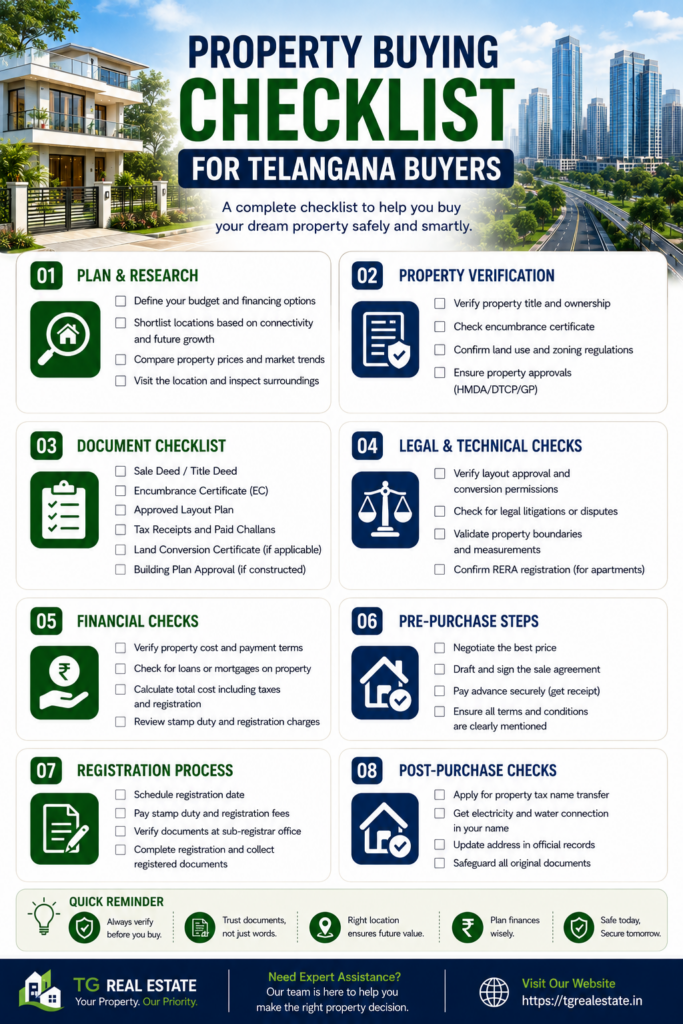
Following this checklist can help ensure a smoother and more secure buying experience.
Buying property is one of the most significant financial decisions you’ll ever make. While the process may seem complex, careful planning, proper legal verification, and informed decision-making can greatly reduce risks and increase the likelihood of a successful investment.
Whether you’re purchasing your first home, investing in a residential plot, expanding your commercial portfolio, or securing land for future development, understanding each stage of the buying journey is essential.
Take the time to research the market, compare properties, verify documents, and seek professional guidance whenever necessary. Real estate is a long-term investment, and informed decisions made today can deliver lasting value for years to come.
Why Choose TG Real Estate?
At TG Real Estate, we believe that buying property should be transparent, secure, and hassle-free. Our mission is to help buyers, sellers, and investors make confident decisions by providing access to verified property listings and reliable market information across Telangana.
Whether you’re looking for:
- HMDA-approved plots
- DTCP-approved layouts
- Apartments
- Villas
- Independent houses
- Farm lands
- Agricultural land
- Commercial properties
- Investment opportunities
our team is committed to helping you find the right property that matches your budget and goals.
From property discovery and document guidance to connecting you with trusted sellers, TG Real Estate aims to simplify every step of your real estate journey.
The Telangana real estate market continues to present exciting opportunities for homebuyers and investors alike. With growing infrastructure, expanding employment hubs, and increasing demand across multiple districts, the state offers strong potential for both lifestyle and long-term investment.
By following the guidance in this Complete Guide to Buying Property in Telangana, you can approach the buying process with greater confidence, avoid common mistakes, and make informed decisions that protect your investment.
Before signing any agreement, remember these four golden rules:
- Verify every document.
- Research the location thoroughly.
- Plan your finances carefully.
- Seek professional legal advice whenever required.
A well-informed buyer is far more likely to enjoy a secure, rewarding, and stress-free property ownership experience.
Trending Posts
-
 Complete Guide to Buying Property in Telangana (2026 Edition)
-
What Documents Should You Verify Before Buying a Plot in Telangana? Complete Document Checklist (2026 Guide)
-
Complete Checklist Before Buying a Plot in Telangana (2026 Guide)
-
Luxury Apartments in Hyderabad: A Complete Guide to Premium Living in 2026
-
HMDA vs DTCP vs Gram Panchayat Layouts: Which Property is Safer to Buy in Telangana?
-
Infrastructure Projects Driving Telangana Real Estate Growth in 2026
-
Affordable Housing in Telangana: Everything You Need to Know About the Indiramma Housing Scheme 2026
-
How New Elevated Corridors Are Increasing Property Values in North Hyderabad
-
New TG RERA Rules 2026: What Every Homebuyer in Telangana Should Know Before Investing
-
Hyderabad Property Prices 2026: Is It Still the Right Time to Buy?


