
Buying a plot is one of the most rewarding investments you can make. Whether your goal is to build your dream home, secure land for future generations, or invest in a fast-growing area, land has traditionally been considered one of the safest long-term assets. Across Telangana—particularly in Hyderabad, Rangareddy, Sangareddy, Medchal-Malkajgiri, Yadadri Bhuvanagiri, Warangal, Karimnagar, and emerging growth corridors—land values have seen significant appreciation due to infrastructure development, industrial expansion, and improved connectivity.
However, buying a plot is very different from purchasing other assets. A plot may appear attractive because of its location or price, but hidden legal or regulatory issues can turn what seems like a good deal into a costly mistake. Cases involving disputed ownership, unapproved layouts, forged documents, encroachments, and incomplete permissions are not uncommon. Many buyers only discover these issues when they try to register the property, apply for a home loan, or obtain building permission.
This is why proper due diligence is essential before making any payment or signing an agreement. A careful verification process protects your investment and reduces the risk of legal disputes, financial losses, or construction delays.
This guide has been created specifically for buyers in Telangana. It covers the key checks you should complete before purchasing a plot, explains why each step matters, and highlights common mistakes to avoid. Whether you’re buying your first residential plot, investing in farmland, or looking for a future development opportunity, following this checklist will help you make a more informed decision.
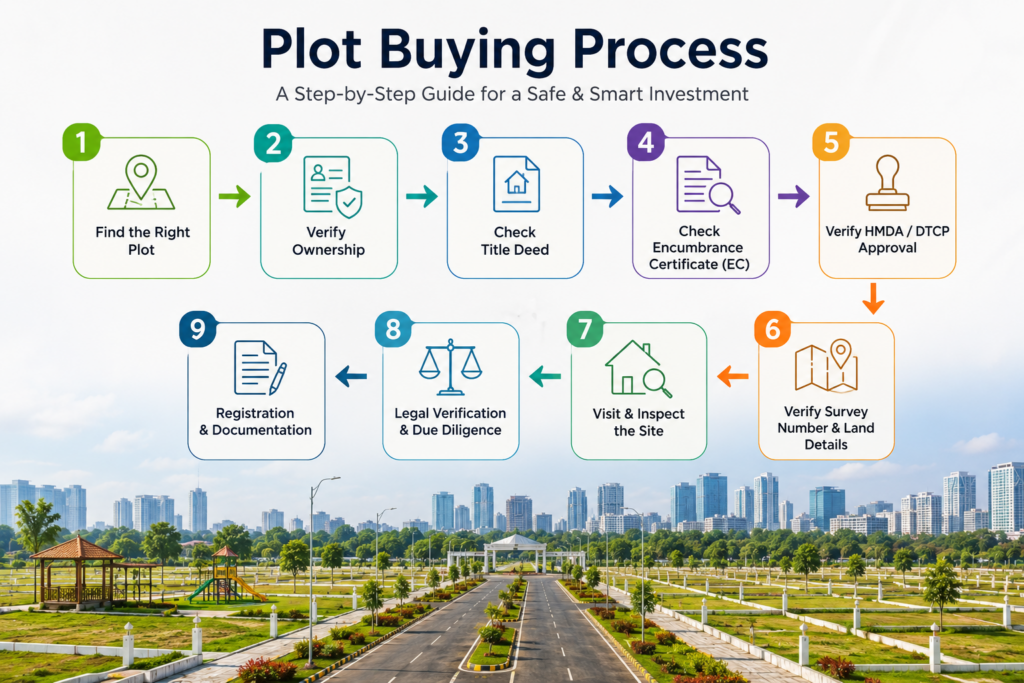
Why Buying a Plot Requires Careful Verification
Unlike apartments or ready-to-move homes, buying a plot involves more than simply comparing prices and locations. The value of land depends on several legal, technical, and planning factors that are not always obvious during a site visit.
Imagine finding a plot at a price significantly lower than surrounding properties. It might seem like an excellent opportunity. But what if the layout was never approved? What if the seller is not the rightful owner? What if the land falls within a proposed road widening plan or a restricted buffer zone? These issues can affect your ability to build, obtain financing, or even retain ownership without future disputes.
Many buyers assume that registration alone guarantees a safe purchase. In reality, registration confirms that a transaction has taken place—it does not automatically verify the legality of the property, the quality of the title, or compliance with planning regulations.
Taking time to verify documents and approvals before purchasing offers several advantages:
- It confirms that the seller has the legal right to sell the property.
- It helps identify outstanding loans, mortgages, or legal claims.
- It ensures the plot complies with applicable planning regulations.
- It improves your chances of obtaining a bank loan.
- It reduces the risk of future disputes or costly legal proceedings.
- It provides confidence that the property can be developed according to applicable regulations.
Buying land should never be rushed. A few days spent verifying documents can prevent years of complications later.
Understanding the Different Types of Layouts in Telangana
Before evaluating a specific plot, it’s important to understand the type of layout in which it is located. This affects building permissions, financing, infrastructure, and long-term value.
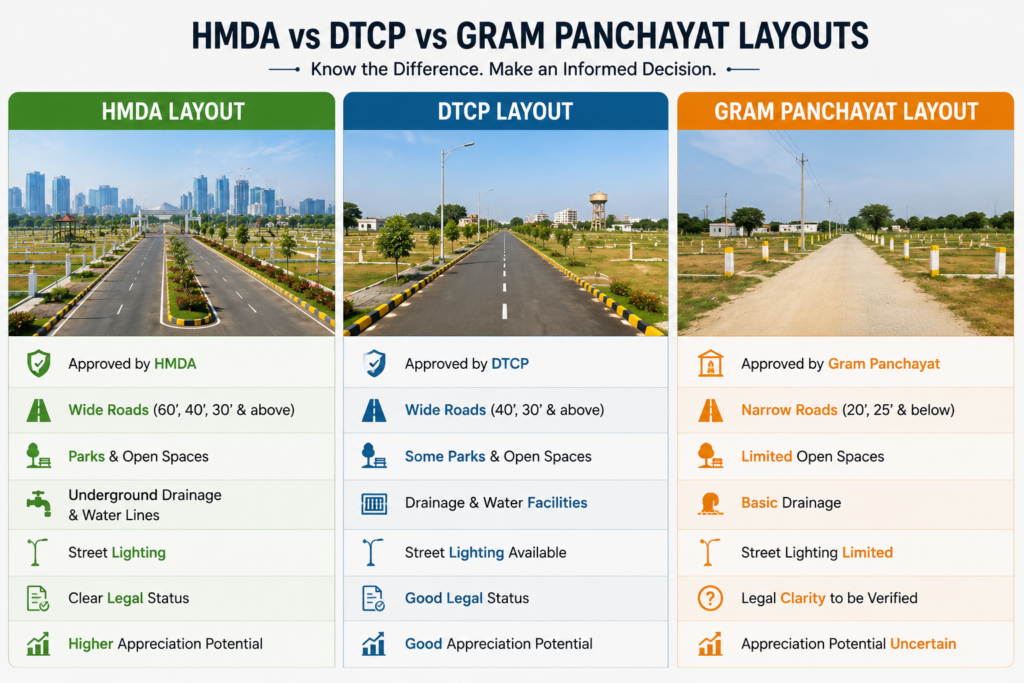
HMDA Approved Layout
HMDA-approved layouts are typically found within the Hyderabad Metropolitan Region. These layouts are planned according to prescribed development standards, including roads, parks, open spaces, and civic amenities. They are generally preferred by homebuyers and investors because they often provide better regulatory clarity and improved access to infrastructure.
DTCP Approved Layout
Outside HMDA limits, layouts may be approved by the Directorate of Town and Country Planning (DTCP). These layouts also follow planning norms and are commonly found in many towns and developing districts across Telangana.
Gram Panchayat Layout
Plots in Gram Panchayat areas are common, especially on the outskirts of cities and in rural regions. Buyers should carefully verify the approval status, applicable regulations, and future development potential before investing. Not every Gram Panchayat layout has the same planning or regulatory status, so individual verification is essential.
Understanding the type of layout is the foundation for many of the checks discussed later in this guide.
Checklist #1 – Verify the Ownership of the Property
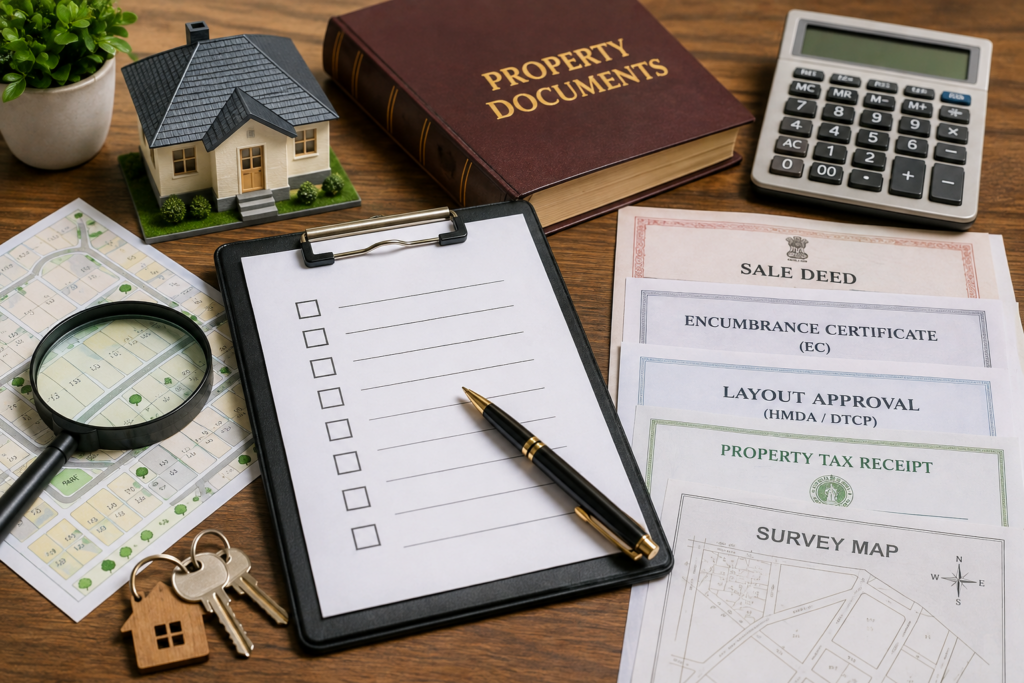
The very first step in buying any plot is confirming that the person selling it is the legitimate owner. This may seem obvious, but ownership disputes remain one of the leading causes of property-related litigation.
Start by asking the seller for the registered Sale Deed and previous ownership documents. These records establish the chain of ownership and show how the property was transferred over time. The seller’s identity should match the details recorded in these documents.
You should also request:
- Aadhaar or another government-issued identity proof
- PAN card
- Recent passport-size photograph (if required during documentation)
- Latest property tax receipts
- Utility records, if available
- Previous title documents
If the property belongs to multiple family members or co-owners, every legal owner should consent to the sale. Purchasing a jointly owned property without the agreement of all owners can lead to disputes later.
When buying property from someone holding a Power of Attorney (PoA), verify that the document is valid, registered where required, and grants the authority to sell the property. If the owner has passed away, ensure that legal succession has been completed before proceeding.
Expert Tip
Never rely solely on verbal assurances. Every ownership claim should be supported by valid legal documents.
Common Mistake
Many buyers assume that long-term possession automatically proves ownership. Possession and legal ownership are not always the same. Always verify ownership through documented evidence.
Checklist #2 – Verify the Property Title
Ownership and title are closely related but not identical. A person may appear to own a property, yet the title could still be affected by unresolved claims, inheritance issues, court cases, or documentation errors.
A clear title means the seller has the legal right to transfer ownership without restrictions or disputes.
When reviewing the title, check that:
- The ownership history is continuous.
- There are no unexplained gaps in ownership.
- The property has been transferred legally.
- There are no pending legal disputes.
- No government acquisition notices affect the land.
- There are no conflicting ownership claims.
For higher-value transactions, many buyers choose to obtain a legal opinion from a qualified property lawyer. A professional title verification can identify issues that may not be obvious from the documents alone.
Why Title Verification Matters
Imagine purchasing a plot only to discover that another family member has challenged the inheritance in court. Even if you’ve already paid for the property, resolving such disputes can take years. Proper title verification significantly reduces this risk.
Expert Tip
Request copies of all available historical ownership documents rather than relying only on the latest Sale Deed. A longer chain of ownership provides greater confidence in the property’s legal history.
Checklist #3 – Obtain an Encumbrance Certificate (EC)
An Encumbrance Certificate (EC) is one of the most important documents you should verify before buying a plot. It provides information about registered transactions affecting the property during a specified period.
The EC helps identify whether the property has been:
- Mortgaged to a bank
- Used as collateral for a loan
- Sold previously
- Gifted to another person
- Subject to certain registered legal transactions
A clean EC is generally a positive sign, but it should never be the only document relied upon. Some matters, such as unregistered agreements or certain legal disputes, may not appear in the certificate. This is why the EC should always be reviewed alongside the title documents and other records.
When requesting an EC, choose a time period that covers the property’s ownership history as comprehensively as possible.
Common Mistake
Some buyers check only the most recent year. It’s often advisable to review a longer period to better understand the property’s transaction history.
Checklist #4 – Verify Layout Approval
One of the most critical steps before buying a plot is confirming whether the layout has been approved by the appropriate planning authority.
An approved layout is generally more likely to comply with planning regulations regarding roads, open spaces, drainage, and public amenities. This can influence future development, financing, and resale potential.
Ask the seller for copies of:
- Layout approval documents
- Approved layout plan
- Plot number
- Approval reference details
Do not rely solely on brochures or marketing materials. Independent verification is always advisable.
Many buyers discover approval issues only after purchasing the property, when they attempt to obtain building permission or sell the plot. Verifying this information before purchase can prevent costly surprises.
Checklist #5 – Understand Whether LRS Applies
Some plots are located in layouts that were originally developed without formal planning approval. In such cases, layout regularization may become an important consideration.
Before purchasing, determine:
- Whether the layout required regularization.
- Whether regularization has been completed.
- Whether any fees or compliance requirements remain.
- Whether the current status could affect future development or approvals.
Understanding the regularization status of a property helps buyers make more informed decisions and avoid unexpected complications later.
Expert Tip
Do not assume every plot in an older layout has already been regularized. Ask for supporting documents and verify the current status before completing the transaction.
Checklist #6 – Verify the Survey Number and Land Records
One of the most overlooked yet essential aspects of buying a plot is verifying the Survey Number. Every parcel of land in Telangana is assigned a unique survey number by the Revenue Department, which serves as the property’s official identity. If the survey number mentioned in the sale deed, layout plan, or registration documents does not match the actual land, you could face legal complications in the future.
Many buyers make the mistake of assuming that the plot number alone is enough. However, plot numbers are assigned within a layout and can change over time, while the survey number identifies the original parcel of land. Both should correspond correctly with the official records.

When reviewing the documents, verify:
- Survey Number
- Sub-Division Number (if applicable)
- Plot Number
- Extent of the land
- Village Name
- Mandal
- District
- Boundaries on all four sides
These details should match across:
- Sale Deed
- Layout Plan
- Encumbrance Certificate
- Property Tax Records
- Revenue Records (where applicable)
If any discrepancies exist, ask the seller for clarification before proceeding.
Example
Suppose the sale deed mentions Survey No. 125/AA, while the approved layout shows Survey No. 126/B. Even if the plot dimensions appear correct, this mismatch should be investigated immediately. It could indicate a documentation error or, in some cases, a more serious issue.
Expert Tip
For larger investments, consider hiring a licensed surveyor to verify the land boundaries and confirm that the physical plot matches the official survey records.
Checklist #7 – Conduct a Physical Site Inspection

Never purchase a plot based solely on photographs, videos, or a brochure. A physical inspection is one of the simplest yet most important steps in the buying process.
Visit the property at least twice—preferably on different days and at different times. A location that appears calm on a weekday morning may experience heavy traffic, flooding, or access issues during evenings or the monsoon season.
During your site visit, check:
Plot Dimensions
Measure the plot or ask a licensed surveyor to verify the dimensions. Ensure they match the approved layout and sale documents.
Boundary Stones
Look for clearly marked boundary stones. Missing or shifted markers can create disputes with neighbouring landowners.
Road Access
Confirm that the plot has proper access from a public road and that the road shown in the layout actually exists on the ground.
Ground Level
Observe whether the plot is:
- Elevated
- Level
- Low-lying
Low-lying plots may require additional filling before construction and could be more susceptible to waterlogging.
Surrounding Development
Take note of nearby developments such as:
- Residential colonies
- Schools
- Hospitals
- Commercial establishments
- Parks
- Public transport
Existing development often indicates the area’s growth potential and availability of civic infrastructure.
Waterlogging
If possible, visit during or after the rainy season to identify drainage issues. Standing water can indicate poor drainage or unsuitable ground conditions.
Encroachments
Ensure there are no temporary structures, fencing disputes, or unauthorized occupation of the plot.
Expert Tip
Use your smartphone to capture photographs and videos during each visit. These records can be useful for future reference and discussions with the seller.
Checklist #8 – Verify Road Access and Connectivity
A plot’s value depends not only on its size but also on how easily it can be accessed. Even a legally clear plot may lose value if it lacks proper connectivity or legal road access.
Before purchasing, confirm:
- Is there a motorable road leading to the plot?
- Is the road public or private?
- Does the road width match the approved layout?
- Is there any proposed road widening?
- Are there future infrastructure projects nearby?
Plots located on wider roads generally offer:
- Better accessibility
- Easier construction
- Higher resale value
- Improved commercial potential
However, if the property is located on a road proposed for widening, part of the land may be affected in the future. Therefore, it is advisable to verify the applicable master plan.
Connectivity Matters
Evaluate the distance to:
- National Highways
- State Highways
- Outer Ring Road (where applicable)
- Railway Stations
- Bus Terminals
- Metro Stations (if relevant)
- Airport
- Schools
- Hospitals
- Shopping Centres
Properties with strong connectivity typically appreciate faster than those in isolated locations.
Expert Tip
Do not rely only on travel time shown in online maps. Visit the route personally during peak traffic hours to understand actual commuting conditions.
Checklist #9 – Confirm Land Use and Zoning
Every piece of land falls under a specific land-use category as defined by the relevant planning authority. Buying land without understanding its zoning can lead to unexpected restrictions on development.
Common land-use categories include:
- Residential
- Commercial
- Industrial
- Agricultural
- Mixed Use
- Public & Semi-Public
- Recreational
For example, purchasing agricultural land with the intention of immediately constructing a residential building may not be possible without complying with the applicable regulations.
Similarly, industrial zoning may not be suitable for residential development.
Why Zoning Is Important
Zoning affects:
- Building permissions
- Property value
- Future development
- Financing
- Resale opportunities
Always verify that the intended use of the property aligns with the applicable planning regulations.
Example
Imagine buying a plot expecting to build a villa, only to discover later that the surrounding area has been designated for industrial development. Such situations can significantly affect both lifestyle and investment value.
Expert Tip
Ask the seller whether the property falls within an approved master plan and request supporting documentation where available.
Checklist #10 – Check Whether the Plot Falls Within Restricted Zones
One of the most important yet frequently ignored aspects of property verification is determining whether the land is affected by environmental or planning restrictions.
Certain locations may have limitations on construction or future development due to environmental regulations or public infrastructure requirements.
Examples include:
Lake Buffer Zones
Plots located close to lakes may be subject to construction restrictions designed to protect water bodies.
River Buffer Zones
Properties near rivers may also fall under regulated buffer areas.
Government Land
Ensure that the plot is privately owned and not part of government land or land reserved for public purposes.
Forest Land
Plots adjoining forest areas may require additional verification regarding ownership and permitted land use.
High-Tension Electricity Corridors
Construction beneath or near major transmission lines may be restricted.
Airport Influence Zones
Plots located near airports may be subject to height restrictions for buildings.
Reserved Public Spaces
Verify that the property is not designated for:
- Parks
- Schools
- Roads
- Utility corridors
- Public buildings
Why This Matters
Buying a plot in a restricted zone could affect:
- Building approvals
- Loan eligibility
- Insurance
- Resale value
Understanding these restrictions before purchasing helps you make a more informed decision.
Checklist #11 – Evaluate Existing Infrastructure
Infrastructure plays a major role in determining both current usability and future appreciation.
When visiting the property, evaluate the availability of:
Roads
Are the internal roads properly developed?
Electricity
Is electricity already available, or will a new connection be required?
Drinking Water
Check the availability of municipal water supply, borewell potential, or other reliable sources.
Drainage
Poor drainage can create long-term maintenance issues.
Street Lighting
Street lighting contributes to safety and indicates the level of civic development.
Internet Connectivity
Reliable broadband and mobile network coverage are increasingly important for both residential living and remote work.
Public Transport
Assess the availability of buses, metro connectivity (where applicable), and other public transport options.
Nearby Facilities
Consider proximity to:
- Schools
- Hospitals
- Banks
- Supermarkets
- Petrol Stations
- Parks
- Pharmacies
Infrastructure and Property Appreciation
Areas with strong infrastructure typically attract more buyers, improve quality of life, and experience better long-term appreciation.
Expert Tip
If major infrastructure projects such as new roads, flyovers, metro extensions, or industrial developments are planned nearby, they can positively influence future property values. However, always verify official announcements rather than relying solely on marketing claims.
Checklist #12 – Assess Future Development Potential

Buying a plot is not just about its present value—it’s also about its future potential. Many of Telangana’s fastest-growing areas have seen significant appreciation because of planned infrastructure, industrial corridors, educational institutions, and commercial developments.
Before investing, ask yourself:
- Is the area expanding?
- Are there upcoming road projects?
- Is there demand for residential housing?
- Are reputed developers launching projects nearby?
- Are schools, hospitals, and commercial centres planned?
Indicators of Growth
Positive signs include:
- New highways
- Flyovers
- Metro expansion
- Industrial parks
- IT corridors
- Logistics hubs
- Educational institutions
- Healthcare facilities
- Government offices
These developments often increase demand for housing and improve long-term investment prospects.
Example
A plot purchased in an area before major infrastructure development may appreciate significantly once roads, public transport, and commercial activity become established. However, investment decisions should always be based on verified information and your financial goals.
Checklist #13 – Verify Property Tax Records
Property tax records are often overlooked, but they provide valuable information about the property’s history and ownership.
Ask the seller for the latest property tax receipts and verify that all dues have been paid. While unpaid property tax does not necessarily mean the property has legal issues, it may indicate unresolved liabilities that should be clarified before the purchase.
What Should You Verify?
Check whether:
- Property tax is paid regularly.
- There are no outstanding dues.
- The owner’s name matches the tax records.
- The property details correspond with the sale documents.
- There are no discrepancies in the plot dimensions or location.
Tax records also help establish a pattern of ownership and demonstrate that the property has been recognized by the local authority for taxation purposes.
Why This Matters
Imagine purchasing a plot only to discover years of unpaid taxes that need to be resolved before certain municipal services or permissions can be obtained. Addressing these issues before the purchase can save time and money.
Expert Tip
Always ask for the latest tax receipt, not one that is several years old. This confirms that the seller has maintained the property records up to date.
Checklist #14 – Check for Pending Legal Disputes
A beautiful plot in a prime location can quickly become a legal headache if it’s involved in litigation.
Before making any payment, ask the seller directly whether the property is involved in:
- Civil court cases
- Family disputes
- Partition disputes
- Boundary disputes
- Government acquisition proceedings
- Encroachment cases
- Inheritance claims
While many sellers are transparent, you should never rely solely on verbal statements. If you’re making a significant investment, consult a qualified property lawyer who can conduct a legal due diligence review.
Common Types of Property Disputes
Family Inheritance Disputes
One family member sells the property without obtaining the consent of other legal heirs.
Boundary Disputes
The actual land on the ground differs from what is mentioned in the documents.
Fake Power of Attorney
Someone attempts to sell the property using an invalid or expired Power of Attorney.
Double Registration Fraud
Unscrupulous sellers may attempt to sell the same property to multiple buyers.
Government Acquisition
The property may be proposed for future road expansion, public infrastructure, or other government projects.
Why Legal Verification Matters
Property litigation can take years to resolve. Spending a small amount on professional legal verification before purchase is often far less expensive than resolving a dispute after registration.
Checklist #15 – Verify Bank Loan Eligibility
Even if you’re planning to purchase the plot using your own funds, checking whether banks are willing to finance it can be an additional indicator of its legal and technical acceptability.
Banks usually conduct their own due diligence before approving a loan. This may include:
- Legal document verification
- Technical inspection
- Layout approval checks
- Valuation
- Ownership verification
If several major banks are willing to finance the property, it generally indicates that the documentation meets their lending requirements. However, this should not replace your own independent verification.
Questions to Ask
- Is the plot eligible for financing?
- Which banks have approved loans for similar plots in the layout?
- Are there any restrictions imposed by lenders?
- Does the property meet the bank’s documentation requirements?
Important Note
Different banks may have different lending policies. Approval by one bank does not automatically guarantee approval by another.
Checklist #16 – Verify the Developer or Seller’s Reputation
Whether you’re purchasing from an individual owner or a real estate developer, it’s important to understand their reputation and track record.
If Buying from an Individual
Ask:
- How long have they owned the property?
- Why are they selling?
- Are all legal heirs aware of the sale?
- Are all original documents available?
If Buying from a Developer
Research:
- Previous projects
- Delivery record
- Customer reviews
- Legal history
- Quality of development
- Infrastructure promised versus delivered
A developer with a strong reputation is generally more likely to complete infrastructure and documentation as promised.
Expert Tip
Avoid making decisions based solely on advertisements or marketing brochures. Independent verification and site visits provide a much clearer picture.
Checklist #17 – Compare the Market Value
Many buyers focus on getting the lowest possible price. While buying below market value can sometimes be a good opportunity, an unusually low price should prompt additional investigation.
Compare Similar Properties
Research:
- Nearby plot prices
- Road-facing plots
- Corner plots
- Similar plot sizes
- Approved layouts
- Recent registrations
Understanding the local market helps you determine whether the asking price is reasonable.
Factors That Influence Plot Prices
- Location
- Road width
- Layout approval
- Infrastructure
- Connectivity
- Future development
- Corner location
- Facing
- Nearby amenities
Expert Tip
Don’t compare only the price per square yard. Consider the overall quality of the location and the legal status of the property.
Checklist #18 – Understand Registration Costs and Other Expenses
Many first-time buyers budget only for the purchase price and overlook the additional costs involved.
These may include:
- Stamp Duty
- Registration Charges
- Legal Fees
- Documentation Charges
- Survey Charges
- Loan Processing Fees (if applicable)
- Miscellaneous administrative expenses
Planning for these costs helps avoid financial surprises during the transaction.
Budget Wisely
In addition to the purchase price, keep a contingency amount for unforeseen expenses such as document corrections, legal consultations, or site-related costs.
Checklist #19 – Avoid Common Real Estate Scams
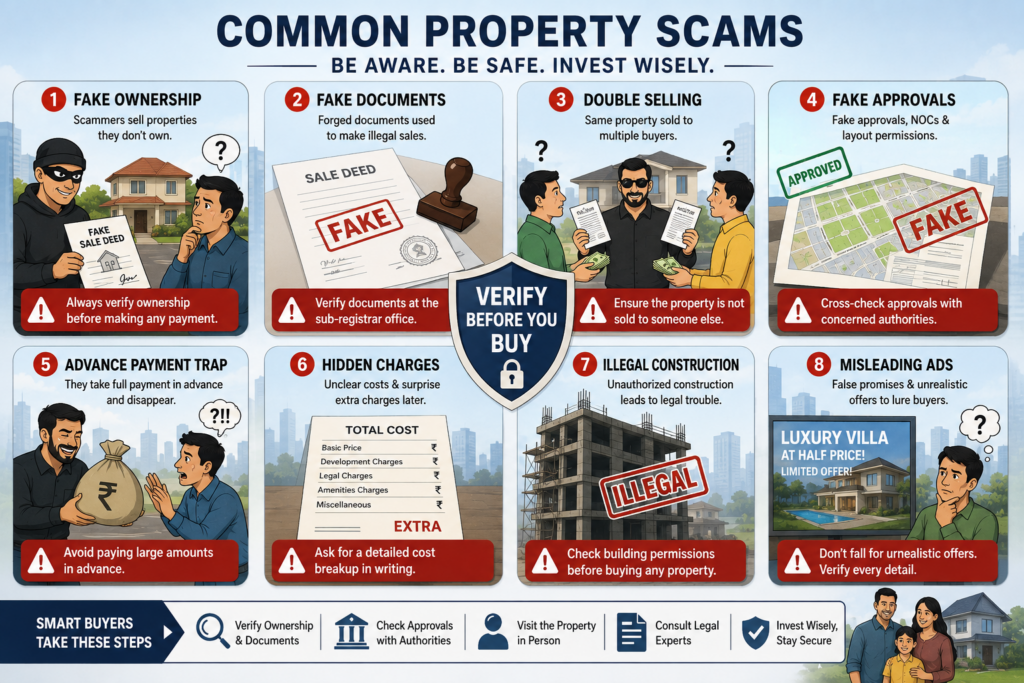
Real estate fraud has become increasingly sophisticated. Being aware of common scams can significantly reduce your risk.
Scam 1 – Fake Documents
Forged sale deeds, layout approvals, or tax receipts may be presented to unsuspecting buyers.
How to Avoid It
Always verify documents through official channels and consult a legal professional when necessary.
Scam 2 – Multiple Sales
The same plot is sold to more than one buyer using different agreements or delayed registrations.
How to Avoid It
Complete proper due diligence and avoid unnecessary delays once verification is complete.
Scam 3 – False Layout Approvals
Some sellers falsely claim that a layout is approved when it is not.
How to Avoid It
Request copies of approval documents and independently verify them.
Scam 4 – Hidden Loans
A property may have been mortgaged without the buyer’s knowledge.
How to Avoid It
Review the Encumbrance Certificate and supporting documentation carefully.
Scam 5 – Encroachments
The physical boundaries may not match the legal boundaries.
How to Avoid It
Conduct a physical survey before purchasing.
Scam 6 – Unrealistic Appreciation Claims
Marketing materials sometimes promise extraordinary future returns without credible evidence.
How to Avoid It
Base your decision on infrastructure, location, demand, and verified development plans—not speculative promises.
Checklist #20 – Hire the Right Professionals
Purchasing a plot is a major investment. Professional guidance can reduce risk and improve confidence throughout the transaction.
Property Lawyer
A qualified lawyer can:
- Verify title documents
- Review sale agreements
- Conduct legal due diligence
- Identify potential risks
Licensed Surveyor
A surveyor can:
- Measure the plot accurately
- Verify boundaries
- Confirm the survey details
- Detect encroachments
Chartered Engineer or Technical Expert
For larger developments or premium properties, a technical inspection may help identify issues related to access, topography, or development feasibility.
Quick Comparison Table
| Verification Item | Why It Matters | Risk if Ignored |
|---|---|---|
| Ownership | Confirms seller has legal rights | Ownership disputes |
| Title | Ensures clear ownership history | Litigation |
| Encumbrance Certificate | Identifies registered liabilities | Hidden loans or mortgages |
| Layout Approval | Confirms planning compliance | Difficulty obtaining approvals |
| Survey Number | Matches legal and physical land | Boundary disputes |
| Site Inspection | Verifies actual conditions | Encroachments or poor access |
| Zoning | Confirms permitted land use | Development restrictions |
| Infrastructure | Influences usability and value | Lower appreciation |
| Property Tax | Identifies unpaid dues | Unexpected liabilities |
| Legal Review | Detects hidden legal issues | Costly disputes |
| Loan Eligibility | Indicates lender confidence | Financing challenges |
Expert Tips for First-Time Plot Buyers
If this is your first property purchase, keep these practical tips in mind:
- Never rush into a purchase because of a “limited-time offer.”
- Visit the site multiple times before making a decision.
- Read every document carefully before signing.
- Retain copies of all agreements and receipts.
- Avoid making large cash payments.
- Ensure all payments are properly documented.
- Consult professionals whenever you have doubts.
- Think long-term—consider not just today’s price but the area’s future development and your own financial goals.
Buying a plot is often a once-in-a-lifetime decision. Taking a systematic approach can help you avoid unnecessary risks and make an informed investment.
Top 10 Mistakes to Avoid When Buying a Plot in Telangana
Even experienced investors can make costly mistakes when purchasing land. Many issues arise not because buyers lack the budget, but because they skip essential verification steps. Avoiding the following mistakes can save you from unnecessary financial and legal complications.
1. Buying a Plot Without Verifying Ownership
One of the most common mistakes is trusting the seller without verifying whether they are the legal owner of the property.
Always check the ownership documents and ensure that the seller has the legal authority to transfer the property.
2. Ignoring Layout Approval
Many buyers assume that every plotted layout is approved. Purchasing land in an unapproved or unauthorized layout can affect future development, financing, and resale.
Always verify the layout approval status with the relevant planning authority.
3. Skipping a Physical Site Visit
Photographs and brochures often show only the best aspects of a property. Visiting the site allows you to assess the actual surroundings, road access, drainage, neighbouring developments, and overall suitability.
If possible, visit the property more than once and at different times of the day.
4. Not Checking the Encumbrance Certificate
A property may appear perfect but could still have an existing mortgage or other registered liabilities.
Reviewing the Encumbrance Certificate is an essential part of the due diligence process.
5. Ignoring Future Development Plans
A plot’s long-term value depends on the area’s future growth. Planned roads, metro extensions, industrial parks, educational institutions, and commercial developments can significantly influence appreciation.
Likewise, proposed road widening or infrastructure projects could affect the property.
6. Believing Every Marketing Promise
Statements such as:
- “Prices will double in one year.”
- “Metro is coming soon.”
- “Airport approval is already finalized.”
should always be verified independently.
Base your decision on official information and your own research—not only on promotional material.
7. Purchasing Solely Based on Price
The cheapest plot is not always the best investment.
Consider:
- Legal clarity
- Infrastructure
- Connectivity
- Future development
- Resale potential
A slightly higher-priced plot in a better location may provide greater long-term value.
8. Ignoring Professional Advice
Some buyers try to save money by skipping legal verification or land surveys.
A lawyer’s review and a licensed surveyor’s inspection can help identify issues before they become expensive problems.
9. Paying Large Advances Without Proper Documentation
Never make substantial payments without:
- A written agreement
- Payment receipts
- Clear terms and conditions
Maintain records of every transaction for future reference.
10. Making an Emotional Decision
Buying property is exciting, but emotional decisions can lead to overlooking important risks.
Take your time, verify everything carefully, and compare multiple options before making a final decision.
Quick Plot Buying Checklist
Use this checklist before finalizing any purchase.
| Verification Item | Status |
|---|---|
| Ownership Verified | ☐ |
| Title Verified | ☐ |
| Sale Deed Reviewed | ☐ |
| Encumbrance Certificate Checked | ☐ |
| Survey Number Verified | ☐ |
| Layout Approval Confirmed | ☐ |
| LRS Status Verified (if applicable) | ☐ |
| Physical Site Inspection Completed | ☐ |
| Boundaries Verified | ☐ |
| Road Access Confirmed | ☐ |
| Zoning Checked | ☐ |
| Restricted Zones Verified | ☐ |
| Property Tax Verified | ☐ |
| Infrastructure Assessed | ☐ |
| Future Development Reviewed | ☐ |
| Market Price Compared | ☐ |
| Legal Opinion Obtained (recommended) | ☐ |
| Registration Costs Estimated | ☐ |
| Home Loan Eligibility Checked (if applicable) | ☐ |
| Original Documents Verified | ☐ |
Tip: Save or print this checklist and use it during every property visit.
Frequently Asked Questions (FAQ)

1. What is the first thing I should check before buying a plot?
Start by verifying ownership and the property’s title. Confirm that the seller has the legal right to sell the property and that the ownership history is clear.
2. Is an HMDA-approved plot always a safe investment?
HMDA-approved layouts generally offer better planning and infrastructure. However, buyers should still verify ownership, title, approvals, and other legal documents before purchasing.
3. Can I buy a plot in a Gram Panchayat layout?
Yes, but you should carefully verify the layout’s approval status, applicable regulations, and future development prospects before making a decision.
4. What is an Encumbrance Certificate (EC)?
An Encumbrance Certificate provides information about registered transactions affecting a property during a specified period, helping buyers identify mortgages or other registered liabilities.
5. Is a Sale Deed enough to prove ownership?
A registered Sale Deed is an important document, but it should be reviewed along with title history, Encumbrance Certificate, tax records, and other relevant documents.
6. Why is the Survey Number important?
The Survey Number uniquely identifies the land parcel and should match across all official records and property documents.
7. Should I hire a lawyer before buying a plot?
For significant investments, obtaining a legal opinion from a qualified property lawyer is highly recommended. It can help identify potential issues before you complete the purchase.
8. Can banks finance every plot?
No. Loan eligibility depends on factors such as legal documentation, approvals, and each bank’s lending policies.
9. How many times should I visit the property?
Ideally, visit the site at least two or three times, including during different times of the day or after rainfall if possible, to assess access and drainage conditions.
10. What documents should I collect from the seller?
Common documents include:
- Sale Deed
- Previous title documents
- Encumbrance Certificate
- Layout approval documents
- Property tax receipts
- Identity proof
- Any additional records relevant to the transaction
11. What should I do if I find discrepancies in the documents?
Do not proceed with the purchase until the discrepancies have been explained and resolved. If necessary, seek professional legal advice.
12. Is buying agricultural land different from buying a residential plot?
Yes. Agricultural land may be subject to different regulations and permitted uses. Buyers should understand the applicable rules before purchasing.
13. How can I estimate whether a location has good appreciation potential?
Look for factors such as:
- Infrastructure development
- Connectivity
- Employment opportunities
- Educational institutions
- Healthcare facilities
- Planned public projects
These indicators often contribute to long-term demand and property value.
14. Should I compare multiple properties before making a decision?
Yes. Comparing several options helps you understand market pricing, identify better opportunities, and negotiate more effectively.
15. Can I rely only on information provided by the seller?
No. Always conduct your own independent verification and consult professionals when necessary.
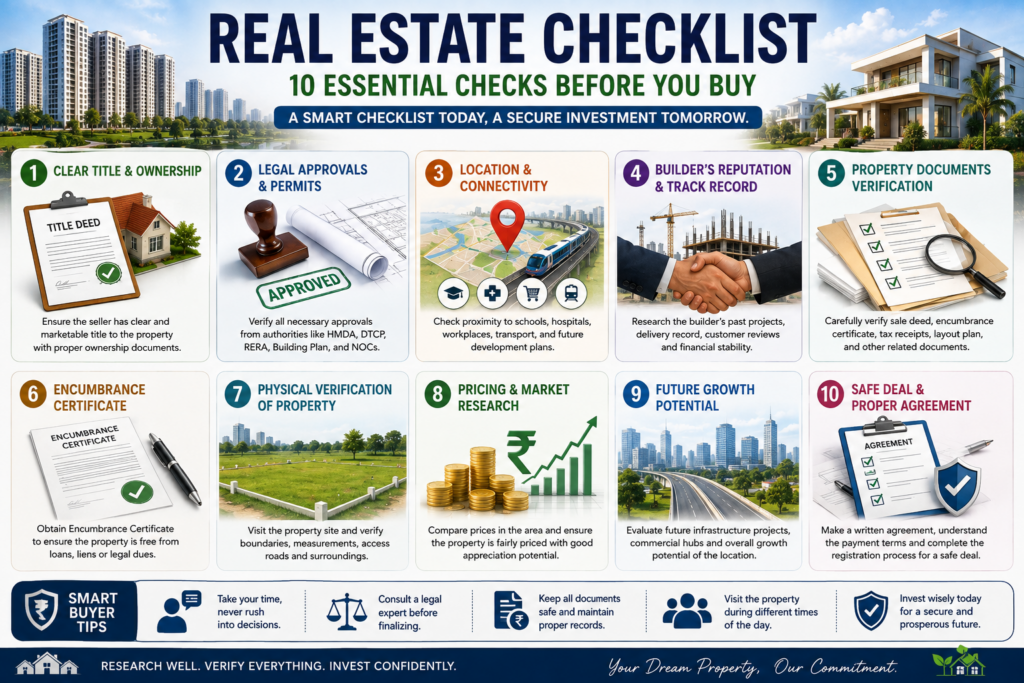
Buying a plot is much more than choosing a location or negotiating a price. A successful purchase is built on careful research, document verification, legal clarity, and a clear understanding of the property’s current status and future potential.
Whether you are purchasing your first residential plot, investing for long-term appreciation, or planning to build your dream home, taking the time to complete every step in this checklist can help you avoid common mistakes and make informed decisions.
Remember that no single document or approval guarantees a completely risk-free transaction. The safest approach is to combine legal verification, technical checks, site inspections, and professional advice before completing the purchase.
Real estate is a long-term investment. The decisions you make today can have a lasting impact on your financial future. A methodical approach, supported by proper due diligence, will give you greater confidence and peace of mind.
Related Articles You Should Read
To continue learning about Telangana real estate, explore these guides:
- HMDA vs DTCP vs Gram Panchayat Layout – What’s the Difference?
- What Is LRS? Importance, Benefits, and Application Process
- How to Verify a Sale Deed Before Buying Property
- How to Check an Encumbrance Certificate (EC) in Telangana
- Building Permission in Telangana: A Complete TG-bPASS Guide
- Property Registration Process in Telangana
- Stamp Duty and Registration Charges in Telangana
- Plot vs Apartment: Which Is a Better Investment?
- Best Places to Buy Plots Near Hyderabad
- Common Real Estate Frauds and How to Avoid Them
About TG Real Estate
At TG Real Estate, our goal is to help buyers, sellers, and investors make informed property decisions across Telangana. Along with verified property listings, we provide educational guides, market insights, and practical resources to simplify the real estate journey.
Whether you’re looking for HMDA-approved plots, residential apartments, villas, agricultural land, or commercial properties, our platform is designed to connect you with genuine opportunities and reliable information.
Explore our latest property listings, compare options, and stay updated with expert guides to make your next real estate decision with confidence.
Trending Posts
-
 Complete Guide to Buying Property in Telangana (2026 Edition)
-
What Documents Should You Verify Before Buying a Plot in Telangana? Complete Document Checklist (2026 Guide)
-
Complete Checklist Before Buying a Plot in Telangana (2026 Guide)
-
Luxury Apartments in Hyderabad: A Complete Guide to Premium Living in 2026
-
HMDA vs DTCP vs Gram Panchayat Layouts: Which Property is Safer to Buy in Telangana?
-
Infrastructure Projects Driving Telangana Real Estate Growth in 2026
-
Affordable Housing in Telangana: Everything You Need to Know About the Indiramma Housing Scheme 2026
-
How New Elevated Corridors Are Increasing Property Values in North Hyderabad
-
New TG RERA Rules 2026: What Every Homebuyer in Telangana Should Know Before Investing
-
Hyderabad Property Prices 2026: Is It Still the Right Time to Buy?


